

Appendices – Appendix C – NOAA’s Functional Model
Functions are the things that an agency does, and will continue to do, in order to fulfill its mission. NOAA’s functions can be considered a disassembly of the components of the NOAA mission. Functions account for NOAA’s productive activities and its outputs, rather than the outcomes that the agency ought to accomplish. Functions are distinct from the people or offices that perform them; a single office, or even a single person, could deploy many functions in a single day.
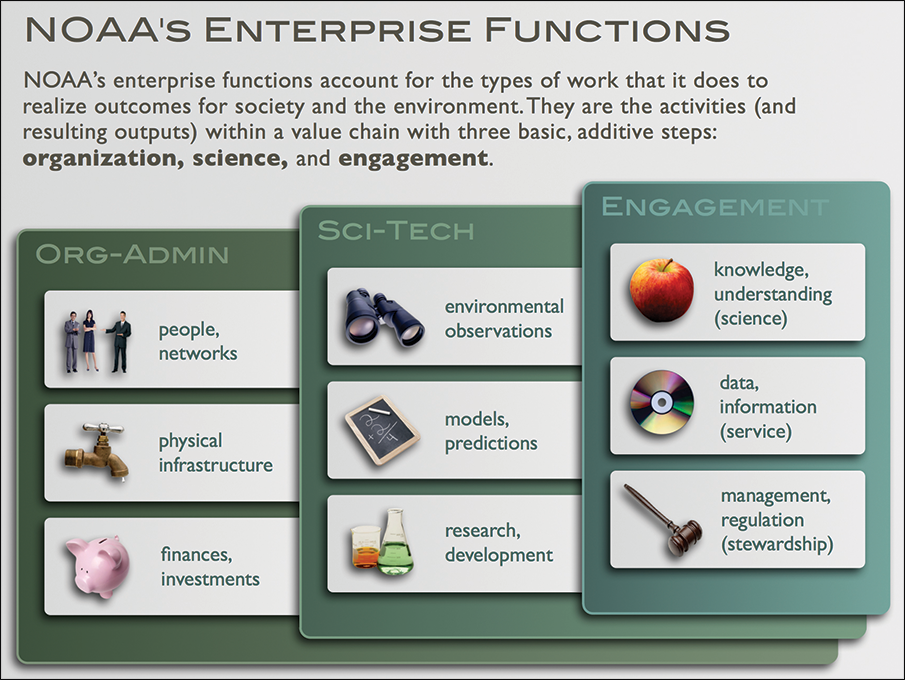
As depicted in Figure C-1, three general types of functions exist. Each is supported by the functions behind it, and is then further detailed by four types of outputs. Functions are links within a value-chain; they add value to inputs to create better outputs. These functions have been derived from statutory mission drivers and thus provide a comprehensive account of what NOAA does. They were developed and refined by a high-level, crossagency working group and then approved by the NOAA Executive Council as an accurate account of the work of the agency. The functions provide a perspective of the work of the agency that transcends disciplinary boundaries, organizational boundaries, people, places, and scale of activity. How NOAA performs these functions over time may change, but – barring a significant change in NOAA’s mission – the functions themselves will not.
Accounting for these functions and their outputs allows NOAA to address where and how the functions should be done and understand the consequences of adding, removing, or integrating functions to the rest of the value chain. The following sections provide a description of each NOAA function and its corresponding outputs.
Figure C-1
NOAA’s Enterprise Functions
Organization and Administration
Management is an essential function of any organization. NOAA’s managers, whether at headquarters or in the field, have common responsibilities to determine and implement policy, manage the investment of taxpayer dollars, deploy physical infrastructure, and retain a qualified workforce. NOAA’s managerial efforts avail the rest of the agency of these four types of inputs. Good management fosters an organizational environment in which core competencies can be realized and final products can reach their fullest potential.
| Policy and Administration
The successful conduct of all of NOAA’s functions requires skilled leadership to coordinate activities and organize people across the agency, as well as with its partners. Policy and administration can be thought of as the compass that aligns the agency to a well-defined mission and guides the agency toward the outcomes most desired by stakeholders. The quality of policy and administration is a function of the fidelity of NOAA priorities with those of stakeholders, as well as the efficacy and efficiency with which all agency capabilities are deployed. |
 |
|
| People and Networks
NOAA’s diverse functions require an equally diverse set of skills and constantly evolving abilities in the workforce, both Federal and contract staff . Human capital can be thought of as the hearts and minds of the organization—NOAA’s passions, values, wisdom, and relationships. The quality of human capital can be understood as the goodness-of-fit of expertise to duty, and individual performance with respect to tasks, as well as professional satisfaction with the work that individuals perform. |
 |
|
| Physical Infrastructure
NOAA creative and engagement functions are extremely capital intensive, demanding satellite systems, ships, buoys, aircraft , research facilities, and high performance computing. Physical capital can be thought of as the utilities of the agency: infrastructure that enables all other functions to be conducted. The quality of physical capital can be measured by how well it meets design requirements, and if it is acquired and maintained on time and within budget. |
 |
|
| Finances and Investments
To achieve its mission effectively and efficiently, NOAA finances are guided by strategic goals and performance evaluations with respect to those goals. Financial capital can be thought of as the monetary investments that NOAA puts into its current and future capabilities to predict the weather, chart coastal waters, etc. The quality of financial capital is determined by the degree to which it is distributed according to strategy and then spent, at a tactical level, per the spending plan. |
 |
At the heart of NOAA operations is the creative work of scientists and engineers. Compared with other public or private institutions, NOAA has an advantage in producing the environmental data, information, and knowledge that is essential to national commerce. NOAA’s core competency is in creating four categories of intellectual capital that informs partners and customers, as well as the agency’s own management and regulation responsibilities. Thus, all four are throughputs with respect to the agency’s final products; they are the necessary ingredients for NOAA’s functions to serve.
| Environmental Observations
NOAA’s science, service, and stewardship functions are dependent upon environmental observation systems composed of satellites, aircraft, ships, buoys, and radars—all of which yield a torrent of data on the state of the oceans and the atmosphere. Environmental observations can be thought of as the raw material from which all of NOAA’s information and knowledge are created. The quality of environmental observations is a function of how well they have been calibrated and validated. |
 |
|
| Models and Predictions
To predict environmental changes, NOAA requires well-designed, often interconnected, models of the environment that are created by Earth system scientists, powered by high-performance computers, and run with extensive observations data. Models and predictions can be thought of as the theories and calculations behind forecasts of future weather and ecosystems conditions, and behind projections of possible climate scenarios. The quality of models and predictions is the accuracy of simulated conditions with respect to actual conditions. |
 |
|
| Research and Development
An evolving understanding of the ocean, atmosphere, and human interactions underlies improved NOAA operations and informed public decisionmaking. Research and development can be thought of as the knowledge-infrastructure that supports current and future understanding of environmental systems. The quality of research and development can be understood as the extent of publication and citation in peer-reviewed journals, as well as the transfer of novel practices into the operational contexts of NOAA or its partners. |
 |
|
| Data Management
Monitoring Earth systems and predicting changes requires the standardization of data and integration of information systems for data archive and access. Data management can be thought of as the organization, quality control, and stewardship of all the environmental information that NOAA requires to run models, conduct research, and manage fisheries, as well as deliver to partners and customers for their own applications. The quality of data management can be determined by consistency of data format, completeness of data sets, and availability of databases. |
 |
NOAA serves the Nation by providing “science, service, and stewardship” through a variety of channels: some digital, others face-to-face; some scientific and technical, others legal and political. From a strategic investment perspective, this translates to the provision of four general types of output, which are the final outputs of the agency as a whole. They are the four types of public goods through which NOAA engages its stakeholders, and thus represent the culmination of all agency work. NOAA’s value to stakeholders is a function of the quality of these outputs.
| Knowledge and Understanding
Beyond data and information, NOAA provides scientific insights into the reasons why environmental processes occur and intangible technical “know-how.” Knowledge and understanding can be thought of as anything you might learn from a NOAA professional, either in direct conversation, at a lecture, or in a publication. The quality of knowledge and understanding is the ability to explain empirical evidence, credibility of the source, and applicability to decisions. |
 |
|
| Data and Information
NOAA provides the data, and the analyses and assessments of those data, that inform the Nation about past, current, and future conditions of the environment. Data and information can be thought of as anything NOAA’s partners or customers might access with a computer or mobile phone. The quality of data and information can be understood as spatial and temporal precision, timeliness, and reliability, as well as user-relevance and accessibility. |
 |
|
| Management and Regulation
NOAA has direct responsibilities to manage national trust resources through activities ranging from law enforcement to protection and restoration. Management and regulation can be thought of as the “boots on the ground” of NOAA’s stewardship responsibilities— such as the authority to enforce fishing quotas or the expertise to protect species and restore coastal habitats. The quality of management and regulation is a function of the sustainability of resources and the balance of competing uses for ecosystem services. |
 |
|
| Grants and Transfers
NOAA often conducts its mission indirectly by supporting and directing external research and development, and state management of coastal zones. Grants and transfers can be thought of as the money and other resources that NOAA allocates to partners, whose activities result in NOAA’s desired outcomes. The quality of grants and transfers is the fidelity to which partner activities and outputs align with NOAA’s mission and abide by contractual agreements. |
 |
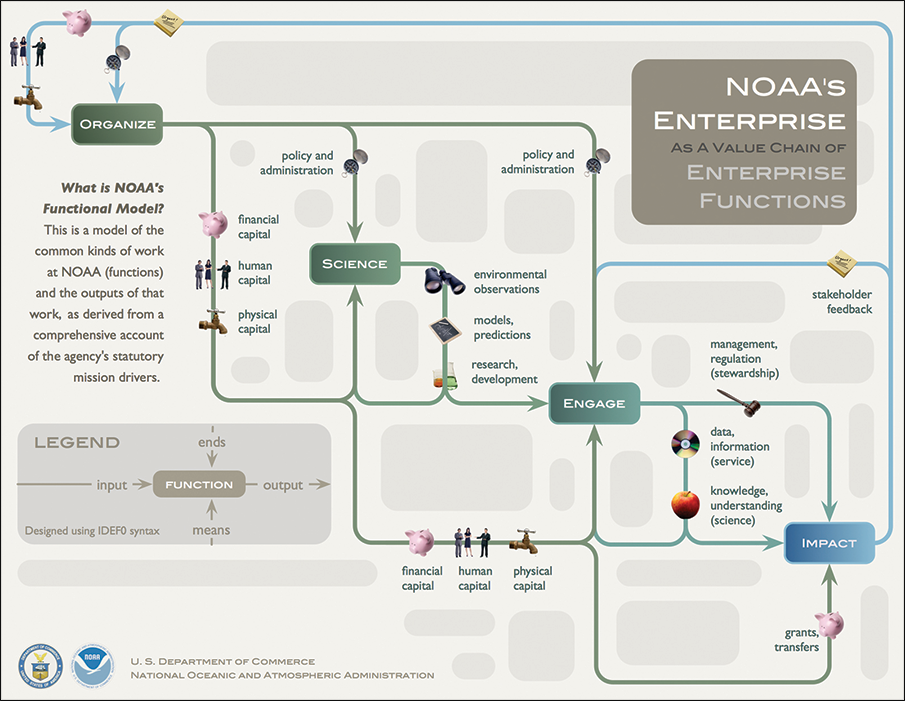
NOAA’s Functional Model specifies how the agency produces and provides particular products (see Figure C-2). The genesis of the Functional Model concept was in the FY2008 Fiscal and Programming Guidance, which stated that PPI “will develop a high-level model that describes NOAA’s enduring functions, how those functions interrelate, and how they could be affected by changing external conditions. This model will enable more detailed function/structure analyses and assessments of alternative CONOPS.” With a Functional Model, agency management at any level can identify best practices, apply lessons learned, find common ground for collaboration, and ultimately improve the efficacy and efficiency with which NOAA conducts its mission.
The Functional Model is also the foundational “business layer” of a NOAA-wide enterprise architecture. Enterprise architecture is a tool for managers of an enterprise such as NOAA to integrate all of the information necessary to sustain the operations of the enterprise, from the requirements, capabilities, and performance measures of the agency as a whole to those of its most particular elements. The structure of enterprise architecture is all of the interrelationships between the information types, which will necessarily parallel the structure of the functions of the enterprise. As the business layer for the NOAA enterprise architecture, the Functional Model provides a common way for NOAA managers to describe the purpose of their major investments.
As depicted in Figure C-2, the Functional Model shows how the outputs of management functions support creative and engagement functions, and how the outputs of these functions support society’s functions to enjoy better decisions and a better quality environment. It also shows how NOAA stakeholders, having enjoyed NOAA’s outputs, will provide feedback on the outputs provided, and ultimately provide the stock of labor, infrastructure, and tax dollars that the agency requires to continue functioning.
Figure C-2
The NOAA Functional Model
The Value of a Functional Perspective
For NOAA’s Next-Generation Strategic Plan, the Functional Model will account for the work of the organization – its inputs and outputs – in order to match evolving capabilities with evolving needs, irrespective of preexisting organizational structure. An effective strategic plan for an organization as complex as NOAA must be founded upon a thorough understanding of all of its functions, how they interrelate, how they add value, and how they perform in meeting their requirements. Strategy must distinguish between ends and means, such that functional approaches to achieving goals can be modified based upon performance assessments.
Functions do not describe NOAA’s budget and authority-based organization, which follows a traditional Line and Staff Office model (and which has culminated from the separate evolution of distinct historical bureaus). This traditional model answers the question, “who has control over what?” Neither do the functions account for NOAA’s vision-based organization, which follows a Goal and Program model. This model answers the question, “why do we do what we do?”
In contrast to both of these existing models, the Functional Model answers the more basic question, “what kinds of things do we do?” It defines agency functions, categorizes those functions, and codifies the discrete value-added relationships between the functions. Understanding, explaining, and discussing “the things we do” in common terms is critical for a successful and accountable organization. The public and its elected representatives are primarily concerned with “what kinds of things we do,” secondarily with “why we do what we do,” and finally with “who has control over what.” The same is true, it might be added, for any specialist within NOAA who requires an understanding of the other areas NOAA and how his or her activities relate to them.
For improved communication throughout the organization, the Functional Model provides a common analytical framework and lexicon for both the NOAA workforce and policy-oriented stakeholders. It will improve the quality and consistency of information exchanged within NOAA, and it will illustrate how NOAA creates value for society, the environment, and the economy for DOC, OMB, and members of Congress. In so doing, it will empower each of these parties to communicate precisely what they need and expect from the others. For instance, it allows for an explicit conversation about whether an information service bottleneck could be overcome by improving functions to observe, model, or distribute final information products.


