

Preface – Timeline

|
The USC&GS, originally the “Survey of the Coast,” was established on February 10, 1807, by President Thomas Jefferson. The increasing importance of waterborne commerce to the new Nation prompted Jefferson to sign legislation to “cause a survey to be taken of coasts of the United States.” Using officers detailed from the Navy (for the seagoing portion of charting) and from the Army Topographical Bureau, the “Survey” conducted its early activities under the U.S. Department of Treasury, where it shared vessels with the Revenue Cutter Service, forerunner of the Coast Guard. |
The NATIONAL OCEANIC AND ATMOSPHERIC ADMINISTRATION (NOAA) traces its roots to some of the oldest agencies in the Federal Government, including the U.S. Coast and Geodetic Survey (USC&GS), which was established in 1807 by President Thomas Jefferson as America’s first physical science agency; the Weather Bureau, which was established in 1870; and the Bureau of Commercial Fisheries, America’s first conservation agency, which was formed in 1871. In 1965, President Lyndon Johnson formed the Environmental Science Services Administration (ESSA) by combining USC&GS, the Weather Bureau, and the Central Radio Propagation Laboratory. ESSA was formed, in the President’s words, to “enable scientists to investigate the physical environment as a ‘scientific whole’” rather than as a “collection of separate and distinct fields of scientific interest.” Within a few years, it became evident that a more complete understanding of the oceans and atmosphere required integrating the study of marine life into the mission of a new agency. With this evidence, the concept of NOAA was born and given life by the Stratton Commission in 1970. To form NOAA, ESSA was joined by other Federal programs, including the Bureau of Commercial Fisheries, National Oceanographic Data Center, National Data Buoy Project, U.S. Lake Survey, and Office of Sea Grant Programs. Much of America’s scientific heritage resides in these programs, and staff brought their expertise in scientific accuracy and precision, stewardship of resources, and protection of life and property to the newly-formed NOAA. The Nation took a major turn toward stewardship of marine resources following the formation of NOAA, and numerous acts were passed which broadened the scope of NOAA’s mission. These included the National Environmental Policy Act of 1969; the Marine Mammal Protection Act, Coastal Zone Management Act, and Marine Protection, Research and Sanctuaries Act in 1972; the Endangered Species Act of 1973; and the Magnuson Fishery Conservation and Management Act of 1976, which established an innovative new management regime for U.S. commercial and recreational fish stocks within 200 miles of U.S. coasts. |

NOAA research and development efforts matured during the 1970s with atmospheric studies, such as the Global Weather Experiment, hurricane research with Project Stormfury, weather modification research, and climate research. In the realm of the ocean, the Manned Undersea Science and Technology Program supported research submersibles, including the famous ALVIN, manned habitats, and projects such as the Florida Aquanaut Research Expedition—the first operational test of a movable habitat supported by a surface vessel. NOAA satellite development also made great strides as the first NOAA-owned and -operated Geostationary Operational Environmental Satellites (GOES) were launched in the mid-1970s; the first NOAA-funded polar-orbiting satellites were also launched during the 1970s. In the 1980s, NOAA was reorganized into its present format of Line Offices: National Weather Service, National Marine Fisheries Service, National Ocean Service, Office of Oceanic and Atmospheric Research, and National Environmental Satellite, Data, and Information Service. A sixth Line Office, Program Planning and Integration, was added in 2002.
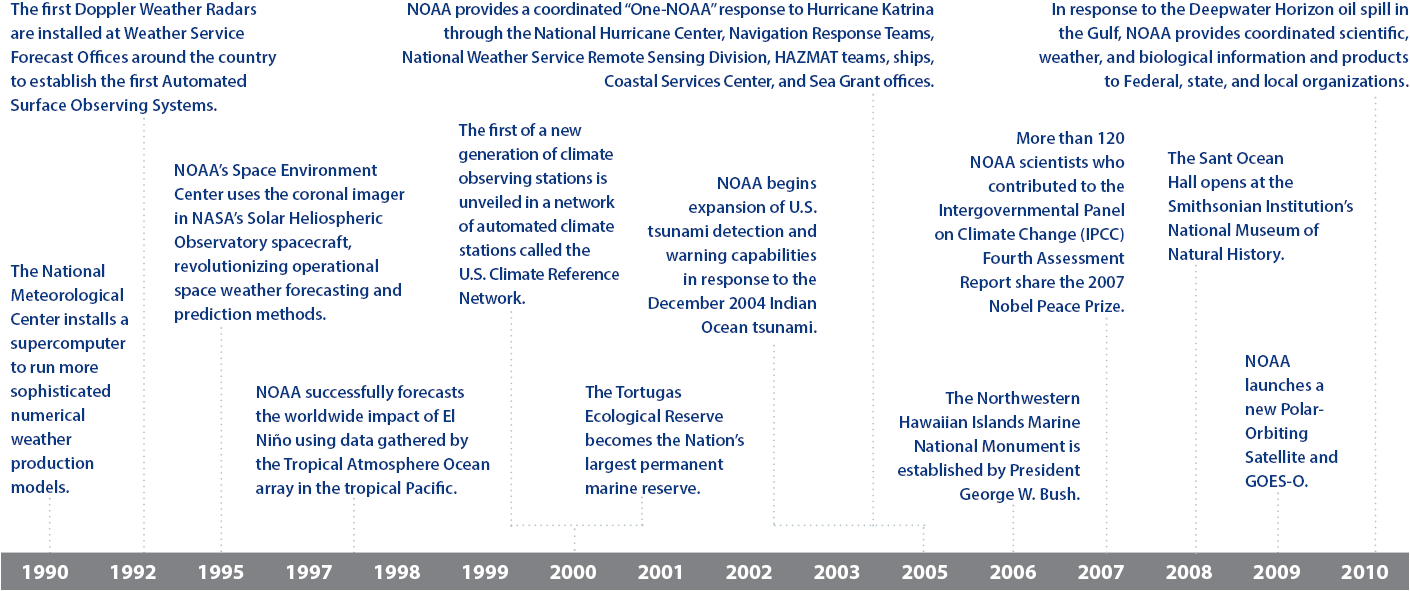
In the last two decades, NOAA scientists have developed new concepts of ecosystem research and management; made discoveries, including the warming of the global ocean; and established the NEXRAD radar system which provides warnings of impending tornados and other severe weather phenomena.
NOAA established the Space Environment Center, which revolutionized operational space weather forecasting and prediction methods, launched ever-improving NOAA satellites that monitor weather patterns and other environmental phenomena, and developed moored ocean observation systems that forecast phenomena such as tsunamis and El Niños. NOAA has advanced navigational aids in support of U.S. commerce, and officers of the NOAA Commissioned Corps operate NOAA ships and aircraft in support of NOAA programs from the Arctic to Antarctic and serve throughout the NOAA organization. Recent events have underscored NOAA’s role as a critical first responder to environmental disasters, including Hurricane Katrina, the 2004 Indian Ocean tsunami, and the Deepwater Horizon oil spill.
NOAA was built on traditions of public service, accuracy and precision of observation, and scientific integrity. Since its inception, NOAA has combined integrated science, innovation, and dedicated personnel to better understand, improve, and protect our oceans and atmosphere. NOAA will continue on this path, creating an enduring legacy for our children, for the environment, and for our Nation.
More information about NOAA’s history is available at www.history.noaa.gov and http://celebrating200years.noaa.gov. Historic images are available in the NOAA Photo Library at www.photolib.noaa.gov.


