

Chapter 3 – NOAA Operations – Information Technology Management
The operational challenges facing NOAA and OCIO are complex and interrelated. For instance, resource limitations not only decrease the number and scope of initiatives that can be undertaken, they also reduce the available workforce. Cyber security threats are not only direct risks to information loss, exposure, or manipulation, they also impact the types of mobile services that can be provided. Our approach to addressing this complexity is to pursue a comprehensive transformation, with enterprise service delivery as the core concept, and incorporating specific elements to address each challenge.
NOAA’s Enterprise Information Service Delivery Model
NOAA’s Enterprise Information Service Delivery Model (Figure 3.8) represents our current vision for how this new business operations model, and these new business practices and technologies, can be arranged to provide improved services, more securely, while avoiding unnecessary costs. Acting more in the role of advisor and broker, the new OCIO will continuously seek opportunities to provide enterprise information services, and deploy them cost-effectively from a centralized, shared infrastructure. Quality of service, security, and customer support are the operational cornerstones of this new operating model. The components of this operating model, and interactions between them, are described below:
Figure 3-8
NOAA’s Enterprise Information Service Delivery Model
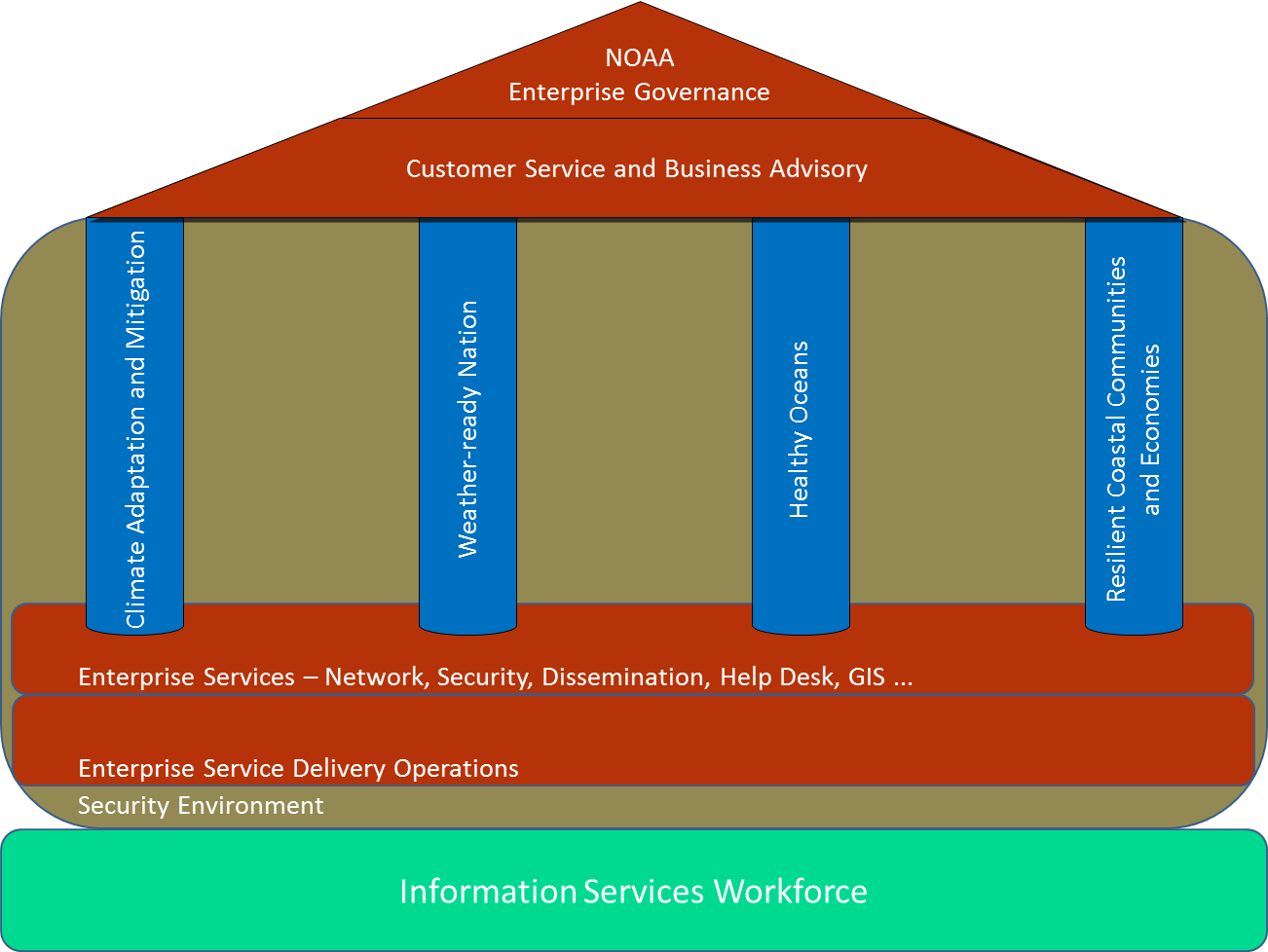
NOAA Enterprise Governance ensures that the appropriate policies for managing risk, performance, and priorities for operating the enterprise information service delivery model are established and enforced. By making these trade-offs and system design decisions at the enterprise level, NOAA will be able to maximize the impact of enterprise information service delivery model on the bureau’s mission.
A critical goal for OCIO in executing the enterprise information service delivery model will be to effectively and efficiently identify, acquire, deploy, and manage enterprise information services. Success will require an engaged, supportive customer service mindset. Just as important is the willingness and ability to understand our customers’ needs and expectations. The Customer Service and Business Advisory function will establish credibility for this operating model by successfully deploying those enterprise services currently underway (Help Desk, Dissemination, Network Optimization, Cyber Security). Ongoing success will require continually meeting clients’ expectations. True transformation will be achieved when we can accurately anticipate and introduce information services that support innovation in the bureau’s execution of its mission.
Mission and management specific services will be required for the foreseeable future. By identifying those truly unique services, and centralizing all enterprise services, the enterprise information service delivery model will allow NOAA to optimize its investment in these critical LO tools.
Significant operational changes will be required to successfully execute the enterprise information service delivery model. Our ability to define and enforce Service Level Agreements, for example, will play a much larger role in determining our success. The Customer Service and Business Advisory component described above will generate a steady stream of potential enterprise services, and our Enterprise Service Delivery Operations will determine which of these services make it into our Enterprise Service portfolio, to ultimately be deployed using the Enterprise Services infrastructure. A critical aspect of enterprise information service delivery model is the ongoing system engineering required to ensure that this infrastructure (internally managed as well as outsourced and cloud-based) continues to meet security, operational, performance, and reliability requirements, even as new services are continuously added.
The Information Services Workforce will continue to be the key resource for delivering information services to the bureau. New skills and behavior will be required in order to operate in the advisory and brokerage functions of the enterprise information service delivery model. Continuous learning will be a part of our culture moving forward, both at the individual level (so that new skills are brought into the bureau) and at the managerial level (so that we learn from our experience and continually improve our performance). Because of the nature and scope of the transformation enterprise information service delivery model requires, a greater tolerance for risk will be necessary. Effectively managing this risk will require greater reliance on our decision making, better informed decisions, and a culture of information and resource sharing.
Goals, Principles, and Operations
Goal 1 – Improve Information Services: Provide world-class information services to end users, enabling innovation, improving science, and providing greater customer satisfaction.
Principles
»An Enterprise Service is any information service that can support more than one Line Office
»Provide secure, remote, and mobile access to all information services
»Facilitate integrated enterprise-wide systems
»Promote openness and transparency
Operations
»IT Portfolio Management
»Shared-Services Operating Model and Roadmap
»Enterprise Service Catalog
»Enterprise Dissemination
»High Performance Computing (HPC)
»Voice over Internet Protocol (VoIP)
»Smartphones
»Web Emergency Operations Center (WebEOC)
»Network Optimization
»Administrative Service Consolidation
»Website Consolidation
Goal 2 – Improve Efficiency of Delivering Information Services: Improve the efficiency of delivering information services across bureau operations and management by employing agile and innovative methodologies, processes, and tools.
Principles
»All enterprise information services will be designed, delivered, and managed using cost-effective, centralized, standard practices, processes, infrastructure, and tools
»Information services acquisitions will be prioritized
»Opportunities to leverage commercial economies of scale and scope will be identified in all acquisitions
Operations
»Enterprise Service Catalog
»IT Portfolio Management
»Strategic investment areas
»Portfolio investment goals
»Continuous allocation and management of funds
»Core business processes
»Baseline business process costs and quality of delivery
»Benchmarks in cost, efficiency, and quality
»Enterprise procurement rationalization and management
»Commodity procurement optimization
Goal 3 – Protect the Mission: Provide worldwide, secure access to data, information, and systems and continuously protect these assets from loss or unauthorized access.
Principles
»Provide prioritized security and risk management for all NOAA information service assets
»Provide an always-available information service infrastructure
»Reduce information service infrastructure complexity by standardizing practices, processes, tools, and technologies
»Deploy enterprise security standards, policies, and tools
Operations
»NOAA-wide risk management policies, processes, standards, and tools
»Trusted Internet Connection Access Providers (TICAPs)
»Security Operation Center (SOC)
»Internet Protocol Version 6 (IPv6)
»Data Center Consolidation
»Mobile Device Management
»Enterprise Security Software
»Homeland Security Presidential Directive (HSPD)-12
»Enterprise Continuous Monitoring and Operations (ECMO)
»Primary Mission Essential Functions (PMEF) analysis, system response data, and scenario responses
Goal 4 – Position the Information Services Workforce: Enable and equip a high performance information services workforce that is highly motivated, customer service oriented, diverse, and focused on transformative goals.
Principles
»Develop a customer service orientation
»Implement Information Technology Infrastructure Library (ITIL)-based approach to defining, delivering, and managing enterprise information services
»Facilitate innovative problem solving
»Provide technical expertise
»Support performance-based management
»Promote a culture of continuous learning
Operations
»Project Management (PM) and Acquisitions certification
»Workforce skills inventory, requirements, and gap-closure program
»Critical workforce performance indicators
»Recruiting and retention opportunities
»Legacy skills maintenance
»Sharing and management transparency
Contact Robert.Swisher@noaa.gov or Dennis.Morgan@noaa.gov for further information.


