

Chapter 3 – NOAA Operations – National Environmental Policy Act
Signed into law in 1970, the National Environmental Policy Act, or NEPA (42 U.S.C. §§ 4321 et seq.), establishes a national environmental policy and provides a framework for understanding the effects that Federal actions have on the human environment. NEPA directs Federal agencies to consider the potential impacts their proposed actions have on the human environment when planning programs and projects. The Council on Environmental Quality (CEQ) oversees the implementation of NEPA.
NEPA Analysis and Documentation
CEQ’s Regulations for Implementing NEPA (40 CFR 1500-1508) require each agency to develop NEPA procedures to meet its specific decisionmaking requirements. NOAA staff follow NOAA’s NEPA procedures, located in: NOAA Administrative Order (NAO) 216-6 at www.nepa.noaa.gov/NAO216_6.pdf.
When proposing Federal actions, NOAA must assess the impacts of the proposed action and any reasonable alternatives on the quality of the human environment. For each proposed NOAA action, AAs and SO Directors designate a Responsible Program Manager (RPM) to oversee the NEPA process. The RPM may be a regional administrator, a science center director, a laboratory director, or a program director within an LO, SO, or Program Office. The RPM is responsible for determining whether NEPA applies to a Federal action, or whether the action is excluded from the NEPA process. The RPM determines the appropriate level of NEPA review needed and transmits NEPA documents to PPI.
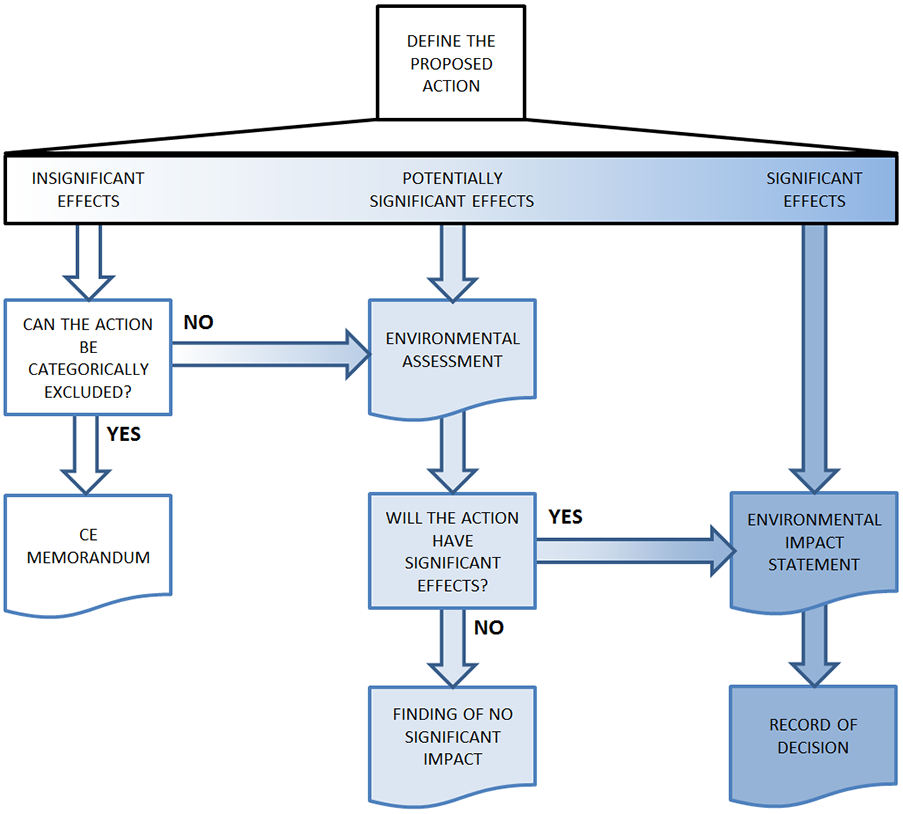
The NEPA process is documented in one of three ways:
- a categorical exclusion (CE) memorandum is issued when no significant effects are anticipated;
- an environmental assessment (EA) is issued when significant effects are possible; and
- an environmental impact statement (EIS) is issued when significant effects are expected.
A CE applies if: 1) a proposed action falls within a class of actions established in NAO 216-6 that neither individually nor cumulatively have a significant impact on the human environment; and 2) there are no extraordinary circumstances warranting an EA or an EIS. If both these conditions apply, the RPM prepares a brief CE memorandum that explains why the proposed action may be categorically excluded from further NEPA review.
An EA is a concise document that analyzes the environmental effects of a proposed action and the reasonable alternatives to that action. The EA process results in either a Finding of No Significant Impact (FONSI), or a determination that the proposed action is likely to result in significant effects, and therefore an EIS must be prepared.
An EIS is a detailed document that assesses the environmental impacts of the proposed action and any reasonable alternatives. The EIS process begins with a Notice of Intent and concludes with a Record of Decision (ROD), a document that explains the outcomes of the NEPA process and the action to be taken.
Figure 3-9
An Overview of the NEPA Process
The NOAA NEPA Coordinator is based in PPI and is responsible for all NOAA-level NEPA policies and procedures. The NOAA NEPA Coordinator, with support from PPI’s NEPA staff, ensures NOAA’s compliance with NEPA.
The NOAA NEPA Coordinator:
»Advises and assists with the NEPA process when requested;
»Reviews all EAs and EISs for NEPA compliance;
»Provides final clearance for all EAs and EISs that comply with NEPA;
»Develops and maintains NOAA’s NEPA policies, procedures, and guidance;
»Develops and provides NOAA NEPA training; and
»Serves as liaison to CEQ and the U.S. Environmental Protection Agency.
The RPM, as designated by an AA or SO Director:
»Determines the appropriate level of NEPA analysis needed for a proposed action;
»Submits NEPA documents and associated letters and memoranda to the AA, SO Director, or delegate for transmittal to PPI; and
»Signs the CE Decision Memos, FONSIs, and RODs, if signature authority has been delegated by the AA or SO Director.
NEPA and Federal Financial Assistance
Multiple LOs and SOs manage Federal financial assistance awards. Guidance issued by PPI and AGO emphasizes the application of NEPA to NOAA’s financial assistance awards, and is available at NEPA Application 2 NOAA FFA 2011.pdf, CE Reporting for Grants.pdf, & FY10 FALD hard earmark memo Jan10.pdf. A summary of the guidance is provided in Table 3-2. Additional information relating to Federal financial assistance awards is available at www.nepa.noaa.gov/grants.html
Additional information on NEPA is available at www.nepa.noaa.gov. More detailed information, including NOAA guidance documents, templates, and examples, is available to NOAA staff at www.intranet.nepa.noaa.gov. The NOAA NEPA handbook, which provides detailed information on NOAA’s NEPA process and preparing NEPA documents, is available at NEPA_HANDBOOK.pdf.
Table 3-2
Summary of NEPA’s Application to Federal Financial Assistance Awards
| LEGAL INSTRUMENT | DEFINITION | EXAMPLE(S) | IS NEPA REQUIRED? |
|---|---|---|---|
|
Grant |
Reflects a relationship between the U.S. Government and a state, a local government, or other recipient when— (1) the principal purpose of the relationship is to transfer a thing of value to the State or local government or other recipient to carry out a public purpose of support or stimulation authorized by a U.S. law instead of acquiring (by purchase, lease, or barter) property or services, and (2) substantial involvement is not expected between the executive agency and the state, local government, or other recipient when carrying out the activity contemplated the agreement.1 NOTE: all “hard earmarks” should be considered grants, where NOAA has no substantial involvement because the mandatory funding of these projects or programs as specified by law circumvents otherwise applicable merit-based or competitive allocation processes, specifies the location or recipient, specifies the purpose of the funding, specifies the funding amount, or otherwise curtails the ability of the executive branch to manage its statutory and constitutional responsibilities pertaining to the funds allocation process.2 |
Federal financial assistance is being awarded to stimulate Non-governmental activity. Federal financial assistance is being awarded for construction of Non-NOAA facility (e.g. museum or Learning Center). NOAA is providing financial assistance to a non-governmental entity to purchase equipment, but has no involvement in selection, operation, maintenance, and disposal. |
Generally – No. There is typically no “substantial” Federal involvement with the nongovernmental entity. The activity remains independent. NOTE: a Grant Program may require NEPA analysis of Federal decision on how to award funds (allocation, need). |
|
Cooperative Agreement |
Reflects a relationship between the U.S. Government and a state, a local government, or other recipient when— (1) the principal purpose of the relationship is to transfer a thing of value to the state, local government, or other recipient to carry out a public purpose of support or stimulation authorized by a U.S. law instead of acquiring (by purchase, lease, or barter) property or services; and (2) substantial involvement is expected between the executive agency and the State, local government, or other recipient when carrying out the activity contemplated the agreement.3 |
Federal financial assistance is being awarded for support and/or research. NOAA and the non-governmental entity work in tandem. NOAA is generally considered the lead. |
Generally – Yes, based on “substantial” Federal involvement. |
|
Contract |
Reflects a relationship between the U.S. Government and a state, a local government, or other recipient when— (1) the principal purpose of the instrument is to acquire (by purchase, lease, or barter) property or services for the direct benefit or use of the U.S. Government; or (2) the agency decides in a specific instance that the use of a procurement contract is appropriate.4 |
Primary purpose of the activity is to acquire a product and/or service for direct benefit or use of Federal Government. |
Yes. Typically accomplished by NOAA prior to procurement or contract award. |
1From Grants and Cooperative Agreement Act of 1977 as amended (31 USC §§ 6301 et seq.)
2Summarized from OMB Guidance to Agencies on Definition of Earmarks, www.earmarks.omb.gov/earmarks_definition.html
3From Grants and Cooperative Agreement Act of 1977 as amended (31 USC §§ 6301 et seq.)
4From Grants and Cooperative Agreement Act of 1977 as amended (31 USC §§ 6301 et seq.)


