

Chapter 3 – NOAA Operations – Acquisition and Grants Management
| Services Provided |
|---|
|
The NOAA AGO is charged with managing NOAA’s acquisition and grants function which is integral to achieving NOAA’s mission. Nearly half of NOAA’s annual appropriations is processed through acquisitions and grants. Acquisition and grants professionals partner with LOs, SOs, and DOC colleagues to manage a complex acquisition and grants process in an environment of constrained budgets and growing demands and expectations.
ORGANIZATIONAL STRUCTURE
In 2005, a new Department Organization Order was signed to move NOAA to a functional management model for its administrative and financial services. This change established direct lines of accountability from headquarters business managers to NOAA financial and administrative field staff. The functional management model, which provides a clear point of accountability in a senior functional manager for each function, aims to increase consistency and application of policy and service levels.
A business process review of AGO was conducted in 2007–2008, which resulted in 2009 in the AGO realigning its organizational structure to provide more timely, responsive, value-added services delivered efficiently and effectively to its clients and stakeholders in support of NOAA’s mission. AGO’s new operating model comprises four key components: 1) the guiding principles of improved communication, improved cooperation, and talented people; 2) consolidation of acquisition requirements; 3) strategic sourcing to create large omnibus contracts for common products and services; and 4) a stronger focus on contract management and acquisition oversight.
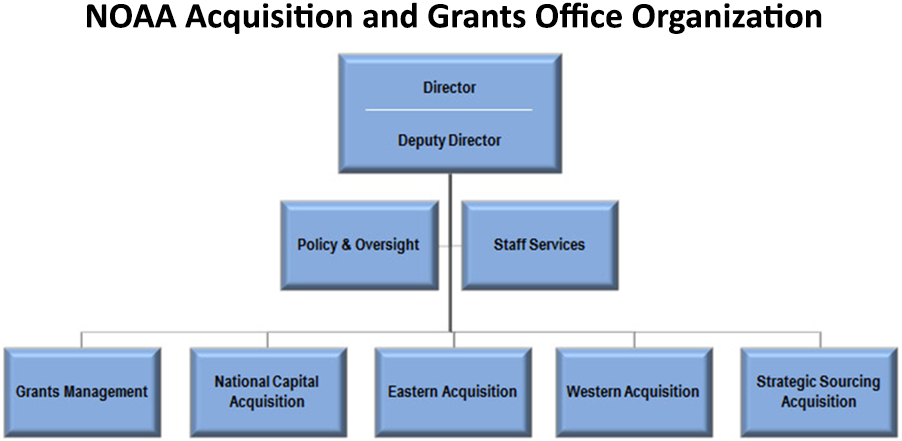
The AGO realignment involved the formal establishment of a Policy and Oversight Division and Staff Services Division, as well as the consolidation of nine geographically-dispersed divisions into only five divisions, headquartered in Silver Spring, Maryland; Norfolk, Virginia; and Seattle, Washington. The Norfolk and Seattle Divisions contain branches servicing clients on site in Kansas City, Missouri, and Boulder, Colorado, respectively. The organization structure of the AGO is depicted in Figure 3-11 (opposite).
AGO ensures acquisitions are processed in a timely, effective and efficient manner. The office works in concert with LOs and SOs as they develop and submit their advanced acquisition plans to ensure that the needs of the programs are communicated. The Western, Eastern, and National Capital Acquisition divisions handle acquisitions in their geographic area of responsibility. The Strategic Sourcing division is responsible for developing and executing omnibus contracts, such as NOAALink, to streamline acquisition of common products and services.
Figure 3-11
The AGO organization
ROLES AND RESPONSIBILITIES
ACQUISITION LIAISONS track acquisition status, including collecting and submitting requests, monitoring request priorities, and disseminating information and communications for respective LOs and SOs. Centralized knowledge management responsibilities include identifying and coordinating the development and dissemination of processes, policies, and standard operating procedures. Acquisition liaisons are also members of the Acquisition Management Advisory Committee (AMAC).
AMAC MEMBERS are part of a NOAA-wide committee with representatives from the acquisition community in NOAA’s LOs and corporate offices, AGO, and DOC. The AMAC consults on high- priority acquisition issues and is vital in communicating changes in legislation, policy, and procedures to the respective offices.
CONTRACTING OFFICER REPRESENTATIVES (CORs) prepare the technical portions of the acquisition package, review the acquisition for accuracy, incorporate guidance from AGO and Budget Execution Analysts, manage contracts using project management standards, align advanced acquisition plans with budgets, report on financials, and close-out contracts.
PURCHASE CARD HOLDERS are issued a government purchase card to purchase supplies and services (typically, up to the micro-purchase threshold) and pay for official expenses in compliance with applicable regulations.
DELEGATIONS OF PROCUREMENT AUTHORITY hold a Contracting Officer’s (CO) warrant and are designated to make purchases up to a predetermined limit above the micro-purchase threshold. Delegations of Procurement Authorities manage their own purchases through the entire lifecycle of the acquisition process, and collect and track metrics to ensure supplies and services are optimally acquired.
ACQUISITION PROGRAM MANAGERS are assigned to oversee and manage all aspects of a single acquisition, or a single program involving multiple acquisitions greater than $10 million in value. This includes managing the acquisition from requirements development through receipt, acceptance, and closeout of the contract.
REQUISITIONERS are responsible for preparing the electronic requisition using C.Request and submitting the requisition to the appropriate Acquisition Division. Requisitioners work with the CORs and Contract Specialists after the acquisition need has been identified through completion of the award. The Requisitioner can also be the COR.
CONTRACTING OFFICERS (COs) are authorized to perform the functions assigned by the Federal acquisition regulations and the Commerce acquisition regulation on behalf of the government based on their specified warrant level. These functions include the development of, entering into, and administration of contracts. COs coordinate and provide advice to stakeholders, and manage contracts to ensure supplies and services are optimally acquired, from pre-award to closeout. A CO may have a Level I (up to $100,000), II (up to $1,000,000), or III (unlimited) warrant.
CONTRACT SPECIALISTS are responsible for processing the solicitation and award of contracts exceeding $100,000 using formal contracting procedures (e.g., sealed bidding, negotiation) and for administering those contracts. Contract Specialists prepare necessary contract modifications and contract actions for CO approval, including changes to key personnel or CORs, application of liquidated damages, Quality Assurance Surveillance Plans, award fees, and assurance of receipt and acceptability of all deliverables in the contract. Contracting Specialists coordinate and provide advice to stakeholders and manage contracts to ensure supplies and services are optimally acquired. This role does not require a warrant.
HEADS OF CONTRACT OFFICE (HCOs) are COs responsible for managing the acquisition activity, day-to-day operations (including purchase card program), and overall performance of their division. HCOs are responsible for conducting customer management and outreach, coordinating and providing advisory services to stakeholders, applying project management techniques to ensure supplies and services are optimally acquired, and managing and developing the workforce. HCOs support audits impacting their regions, are responsible for change management and continuous improvement, and participate in the development of operational strategies. HCOs hold Level III warrants with unlimited procurement authority.
POLICY AND OVERSIGHT DIVISION DIRECTORS are responsible for managing acquisition policy; overseeing AGO operating practices to facilitate consistent and efficient operating methods; developing acquisition system requirements, training, and communications; and conducting compliance audits of AGO Divisions, field delegate files, and purchase cardholder records. Policy and Oversight Division Directors are also responsible for the technical support and infrastructure of the AGO website to improve self-service options for customers and AGO staff.
PROCUREMENT OFFICIALS are the senior individual responsible for overall acquisition authority within a bureau, including sign-off on the largest procurements. Procurement Officials have an outward-facing role, liaising with the DOC on acquisition policy, systems, and legal matters, and responding to audit matters with the OIG and GAO. Procurement Officials represent NOAA on the Department Acquisition Council. In addition, Procurement Officials make final budget and operational strategy decisions and are responsible for strategic partnerships. Procurement Officials hold Level III warrants with unlimited procurement authority.
PURCHASING AGENTS are responsible for buying supplies or services valued under $100,000 using simplified acquisition procedures for the organization. Purchasing Agents also issue orders against established contracts, such as GSA Federal Supply Schedule contracts and blanket purchase agreements. This role does not require a warrant.
ADDITIONAL INFORMATION
More information on NOAA Acquisition, including AGO guidance and policies, is available at www.ago.noaa.gov. The NOAA Acquisition Handbook provides detailed information on NOAA’s acquisition policies and requirements and is available at
NOAA Acquisition Handbook part 1 Version 3.1.pdf
and
NOAA Acquisition Handbook part 2 Version 3.1.pdf
NOAA’s Acquisition Process Guide provides information on the end-to-end acquisition process, as well as templates, guides, and other documents for use by NOAA staff involved in any part of the acquisition process. The guide is available at www.easc.noaa.gov/apG/apG_home.htm.
The Grants Management Division (GMD) manages grants and cooperative agreements from a centralized location in Silver Spring. GMD serves as the single conduit and final decision station for all fiscal actions involving grants and cooperative agreements. Approximately one-fourth of NOAA’s annual appropriations is expended through grants and cooperative agreements.
|
A GRANT AGREEMENT is the preferred assistance instrument if no substantial involvement is anticipated between the Federal Government and the recipient during the performance of the assistance activities. A COOPERATIVE AGREEMENT is the preferred assistance instrument if substantial involvement is anticipated between the Federal Government and the recipient during the performance of the assistance activities. |
|
All grants and cooperative agreements are either non-discretionary or discretionary: NON-DISCRETIONARY AWARDS are those for which applicants and authorized activities are designated by statute. DISCRETIONARY AWARDS are those for which the applicant and authorized activities are not identifi ed by statute and awards may be made based on the authorizing legislation, preferably and usually through a competitive award process. |
ASSISTANCE INSTRUMENTS
Grants and cooperative agreements are two kinds of assistance instruments awarded by the Federal Government. An assistance instrument is used when principal purpose of the relationship between the Federal Government and the recipient is the transfer of money, property, services, or anything of value to accomplish a public purpose of support or stimulation authorized by Federal law.
Grants and cooperative agreements are the only awards made by GMD.
TYPES OF GRANTS AND COOPERATIVE AGREEMENTS
COMPETITIVE AWARDS are a kind of discretionary award in which NOAA announces fund availability through www.grants.gov and other public venues. Eligible applicants are defined, areas of interest described, number and amounts of anticipated awards identified, and review criteria specified.
NON-COMPETITIVE AWARDS are a kind of discretionary award in which NOAA does not announce availability of funds. A prospective applicant requests support for a particular project or range of activities which can be supported by law and is so unusual or outstanding that it could not have been supported under a current or recent funding announcement. Funding the activity is determined through a separate and rigorous approval process.
FORMULA AWARDS are a kind of non-discretionary award to states and territories, which must be awarded if the eligible applicant meets certain qualifying conditions and submits an acceptable proposal. A statutorily-determined formula determines the eligibility for and distribution of funds.
CONGRESSIONALLY-MANDATED AWARDS are a kind of non-discretionary award in which the recipient and usually the activity to be funded are identified in a law. No funds may be utilized by NOAA for award, monitoring, or participation in the activities of these awards.
SOFT EARMARKS are a kind of discretionary award in which the recipient and activity to be funded are identified in a Congressional conference or committee language. A reasonable amount of funds may be utilized by NOAA for award, monitoring, or participation in the activities of these awards.
INSTITUTIONAL AWARDS are a kind of discretionary award in which long-term relationships are established between NOAA and large research organizations, usually universities, revolving around a specific research theme or themes. These are generally competed and are awarded for up to five years with a potential for renewal.
| Fundamental Project Management Principles |
|---|
|
| OMB 300′s |
|---|
|
OMB requires the completion of an Exhibit 300 to facilitate the collection of information for Congress and to ensure the case for business investments is made and tied to long-term goals, objectives, and performance. In general, an Exhibit 300 must be submitted with the official NOAA budget request for all major projects. |
Project management is the discipline of planning, organizing, and managing resources to bring about the successful completion of specific project goals and objectives. A project is a finite endeavor, with specific start and completion dates. A project is undertaken to create a unique product or service which brings about beneficial change or added value. This finite characteristic of projects stands in sharp contrast to processes, or operations, which are permanent or semi-permanent functional work to repetitively produce the same product or service.
MAJOR PROJECTS
To ensure the appropriate level of senior management oversight for significant projects, NOAA has established criteria to identify those projects which are considered major investments. Major projects in NOAA are defined as any project with life-cycle costs greater than the NOAA-established threshold of $250 million (FY 2005 constant dollars), or otherwise directed by DOC or a higher authority. The life-cycle cost determination should be computed over the service life for physical assets, and over 10 years for other types of projects.
Five criteria distinguish which NOAA projects qualify for the distinction of ‘major’ and therefore require direct senior level oversight. These criteria are explained in Table 3-3. The DUSO may also designate any project as a major project regardless of its life-cycle costs or criteria.
MONITORING MAJOR PROJECTS
Major projects are monitored through their life-cycle by establishing KDPs. The requirement for KDPs for major projects is documented in NAO 216-108 regarding requirements management. A KDP is a significant milestone in the project life-cycle and results in an agency investment decision. In general, the KDPs are structured as follows:
KDP-1 [NEEDS IDENTIFICATION AND DEFINITION]: Identification and definition of shortfalls, and the general magnitude of life-cycle costs that may be needed to address them.
KDP-2 [SOLUTION ALTERNATIVES IDENTIFICATION]: Selection of one or more alternatives to be advanced for further analysis (including research and pilot testing).
KDP-3 [SOLUTION SELECTION]: Selection of an approach, including project scope, review procedures, and commitment as appropriate to full-scale research and development.
KDP-4 [ACQUISITION/IMPLEMENTATION APPROVAL]: Commitment to full acquisition and/or operational implementation, with explicit approval of baseline objectives and project scope to include life-cycle cost, schedule, and performance goals. For systems acquisitions, NAOs and DAOs may provide different and more specific requirements or definitions.
Table 3-3
Major project selection criteria
|
SELECTION CRITERIA |
EXPLANATION |
|
High development, operating or maintenance costs: acquisitions with life-cycle costs that meet thresholds included in NAO 216-108 ($250M in FY 05) |
While all projects require some level of oversight, the intent is to provide senior level input to those projects that have major fiscal impact. |
|
High/broad scope of impact to agency’s mission |
Projects that are broad in scope are by nature high risk due to the organizational interaction and coordination required to maintain cost, schedule, and performance. Projects that do not have a high/broad scope of impact to the Agency’s mission can be effectively monitored at the individual LO/SO or program level. |
|
High fiscal and management risk |
High-risk projects require the active engagement of senior managers in order to resolve identified risks and maintain cost, schedule, and performance objectives. Projects that do not have high fiscal and management risk can be effectively monitored at the LO or program level. |
|
Unique product, service or result—not a bundling of efforts |
It is difficult, if not impossible, to track all the permutations of a bundled effort. Bundled efforts tend to be program efforts rather than specific projects. |
|
New acquisition starts vice current and ongoing levels of effort |
The intent is to track efforts that have a defined beginning and end, not those that are operational in nature and continuously provide NOAA products and services. |
| Project Manager Responsibilities |
|---|
|
APPOINTING NOAA MAJOR PROJECT MANAGERS
Project Managers are responsible for managing the life-cycle of a project to meet requirements. One of the principal outcomes entailed in this responsibility is the delivery of projects on schedule, within budget, and with the required performance capability. All major projects will have an assigned project manager. The Project Manager is responsible for translating mission requirements into set project milestones and deliverables to ensure a satisfactory solution is delivered. The Project Manager establishes and maintains a process to manage change throughout the project’s life-cycle. The Project Manager is responsible for preparing documentation to support the continuous and systematic review of progress as it relates to KDPs and meeting mission requirements.
Nominees for Major Project Managers must be at least a career level GS-14 or equivalent, and have leadership qualifications and subject area competencies. A strong Major Project Manager candidate will have the capability to coordinate and communicate program content with the NOAA senior leadership; provide overall integration, oversight, and assistance to the program’s constituent projects; and effectively manage the successful accomplishment of a project that meets the requirements of the customer.
MAJOR PROJECT MANAGER TRAINING REQUIREMENTS
OMB’s memorandum on the Federal Acquisition Certification for Program and Project Managers (www.whitehouse.gov/omb/procurement/workforce/fed_acq_cert_042507.pdf) outlines the essential competencies needed to be a Program or Project Manager. The certification program does not cover functional or technical competencies, such as those for IT or agency-specific competencies. The certification is required for Program and Project Managers that are assigned to major investments as defined in OMB Circular A-11, Part 7, Exhibit 300 (www.whitehouse.gov/sites/default/files/omb/assets/a11_current_year/a_11_2012.pdf). The target completion date for the certification is one year from the date of assignment to the program or project. Project Managers assigned to programs considered major acquisitions should be senior-level certified or granted a waiver from their LO or SO. LOs and SOs can consider the competencies and experience of the Project Manager along with associated training. OMB recommends that interactive training be completed that encompasses strategic thinking, vision, and external awareness.
Additional information on AGO, including guidance and policies on NOAA grants, is available at www.ago.noaa.gov.
More information on the management of NOAA’s Major Projects is available by contacting the PPI office.


