

Chapter 3 – NOAA Operations – Facilities Management
| Services Provided |
|---|
|
»A safe operating environment with efficient and effective support services »A policy of procedures and valuation criteria that aligns Real Property to achieve NOAA’s Overall mission »Integration of facilities investment decisions into the Strategy, Execution and Evaluation (SEE) process |
NOAA’s real property inventory includes approximately 750 buildings, of which 58 percent are DOC-owned and 42 percent are DOC-leased or assigned by the U.S. General Services Administration (GSA). These facilities are located throughout the 50 states, Guam, Puerto Rico, and the Pacific region. The scope of NOAA’s facilities management encompasses all new construction; major and minor renovation and repair; and operations and maintenance of real property inventory, facilities physical security, and environmental compliance projects affecting facilities.
The NOAA Facilities Program comprises the following interrelated functional areas:
Capital planning and budgeting:
»Long-range facilities program planning
»Policy development
»Program execution
Asset management and maintenance:
»Operations and maintenance
»Integrated facility condition assessment
»Policy and oversight of real property acquisition
»Operating leases
»Asset management services
Project planning and management:
»Planning and life-cycle project management
»Construction project management
»Policies and processes for project planning, project management, and progress/ performance metrics (including earned value management reporting)
»Coordination of the development of alternatives
»Selection of service provider
»Acquisition strategy
»Executive level oversight, coordination, and reporting for all major construction projects
NOAA Facilities Program Management
The dynamic nature and diversity of NOAA’s mission, staff, operations, and the geographic dispersion of its facilities create unique challenges to effectively planning and managing its facility portfolio. The business model employed by NOAA under these conditions must acknowledge the necessary balance between centralization of strategic business and investment decisions, investment management, and decentralized program execution due to regional and local requirements. To manage its facility assets effectively, NOAA adopted the following framework for ensuring alignment of facility investment decisions with the NOAA Next Generation Strategic Plan (NGSP) objective.
Figure 3-1
Facility Modernization Initiative: Framework
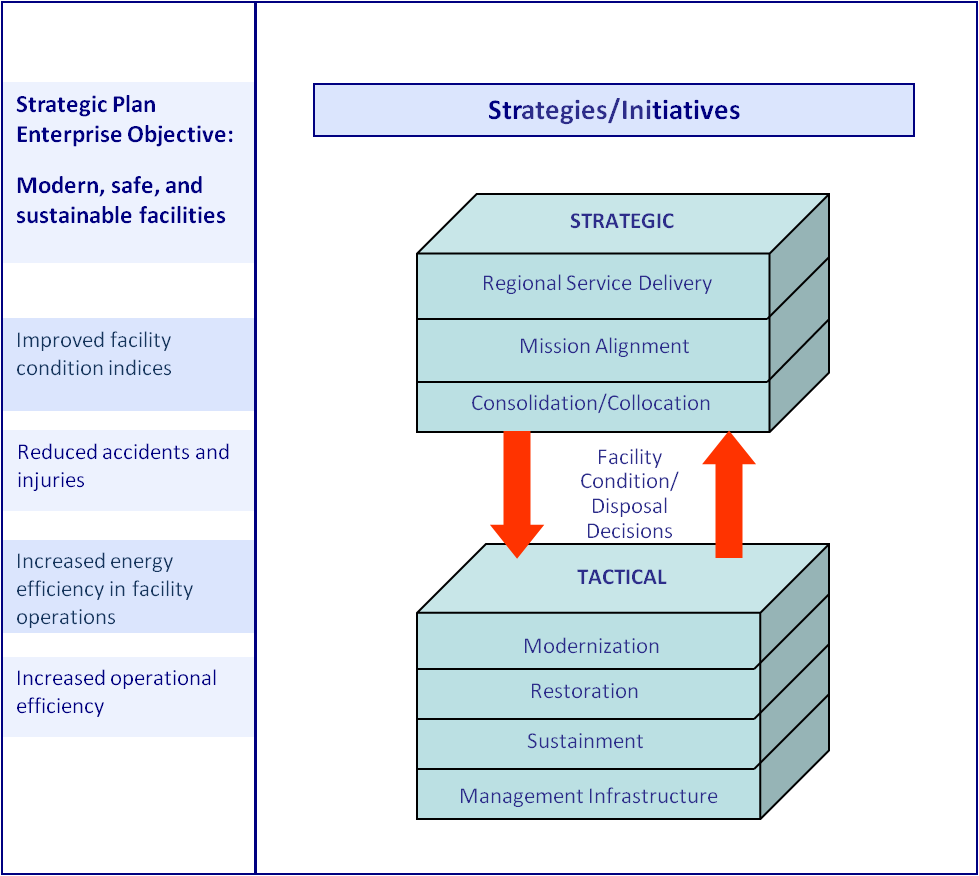
Decisions concerning courses of action at the strategic level are driven by portfolio level analysis, mission requirements, and NOAA corporate direction, while tactical-level execution is driven by facilities condition, mission criticality, usage, and overall costs in accordance with EO 13327.
TACTICAL COMPONENTS The following components ensure that NOAA’s current facility portfolio is maintained at safe and operationally sustainable levels and that NOAA is able to effectively manage its facility program:
Management Infrastructure: Manage organizational resources, governance policies, processes, transactional and informational databases, and performance measurement systems.
Purpose: Plan and manage the NOAA real property portfolio.
Sustainment: Required ongoing maintenance and repairs, including regularly scheduled maintenance and periodic repairs of systems (such as replacing roofs) that are expected to occur over the expected service life of the facilities. Also includes investments in security measures based on security/threat assessments, environmental compliance and safety needs. Sustainment normally does not specifically address upgrades for new building codes or other laws such as accessibility. Funding and executing sustainment is normally the responsibility of the Line Office or Program that “owns” and occupies the facility.
Sustaining facilities at an adequate level is critical to any good, balanced facilities program; a lack of appropriate sustainment results in increasing backlogs of repairs and continued deterioration of facilities. Under‐sustainment of facilities reduces facility life and requires larger investments at earlier times in the future to revitalize failing facilities. Under-sustainment also often leads to increased risk of health and safety problems such as water intrusion or inadequate heating and ventilation leading to the growth of mold or the development of bacterial infections such as Legionnaire’s Disease. Improving facility condition through restoration projects is more difficult if facilities are not sustained adequately.
Purpose: Maintain safe, secure, and operational working environments. Ensure appropriate level of annual investments in routine maintenance and repairs to maintain facilities and sustain their useful life.
Restoration: Repair and restoration work to address deficiencies and damage to existing facilities caused by inadequate sustainment, natural disasters, fires, accidents, or other incidents. Projects below $10 million are usually categorized as restoration. Restoration projects can include upgrades or renovations specifically required to comply with new building codes or laws, such as accessibility and Historic preservation.
Under‐funding of restoration results in increased facility deterioration (one study estimated that repair backlogs increase by 5%‐10% per year simply due to not addressing current repair needs), and decreased facility life.[1] Failure to take timely restoration actions can also lead to potential facility failures, safety and health hazards such as the growth of mold, or environmental issues such as the release of asbestos or lead based paint. The “Facility Life Cycle Performance Curve Model,” below, shows the relationship of restoration with facility life and FCI.
Purpose: Restore NOAA facilities (owned and leased) to “Good” or “Excellent” FCI, and address critical facility condition issues; improve working conditions and facility reliability in support of NOAA mission.
[1] Rush, Sean C., “Managing the Facilities portfolio: A practical approach to institutional renewal and deferred maintenance.” Applied Management Engineering, 1991.
Modernization: Major renovation, reconstruction, or modernization activities, including replacement of individual facilities, necessary to keep an existing inventory of facilities modern and relevant in an environment of changing standards and missions and to extend the lives of existing facilities. Projects $10 million or greater are normally categorized as Modernization.
Modernization projects will address current building code and other legal requirements, as well as implement new building and facility technologies to reduce facility life cycle costs and comply with the principles of environmental sustainability.
Projects may include the demolition and replacement of existing facilities which may be addressed through new leases rather than construction and ownership. Modernization can also address consolidation of currently dispersed NOAA owned or leased facilities into a smaller number of collocated facilities to increase program effectiveness and reduce facility operating costs. Modernization investments address facility aging and obsolescence. Without such investments, maintenance, repair, and facility operations costs will increase due to facility age and obsolescence, and the risk of mission failure increases. Timely investments to modernize/recapitalize facilities extend the life of facilities.
Purpose: Ensure NOAA maintains a modern facilities inventory relevant in an environment of changing standards and missions, improve conditions, reduce life-cycle cost and increase facility useful life to support NOAA mission.
STRATEGIC COMPONENTS To maintain NOAA’s current facility portfolio, additional strategic business objectives impact NOAA’s facility investment planning. Three specific business drivers to ensure continued alignment of the facility portfolio with NOAA’s mission and business objectives are discussed below:
Consolidation/Collocation–Enhanced Collocation/Effective Space Management: The increasing complexity of the climate, ecosystem, weather, oceans, and coastal issues facing the Nation require integrated solutions across NOAA and its partners. We recognize the opportunities to optimize NOAA mission accomplishment—in research, science, and operations—through improved integration and collaboration. Collocation—at the NOAA level, across line offices, and between NOAA and its partners, including academia, state and Federal agencies—offers unique opportunities to advance these opportunities for collaboration and integration. In addition to enhanced program integration and synergies and improved solutions and service delivery, collocation can promote improved operational efficiencies through better integration of resources.
Purpose: Promote effective space management practices, program collocation, and consolidation opportunities to enhance program collaboration and synergies and improve operational efficiencies. Leverage opportunities to partner with external organizations—academia, state and Federal agencies—to optimize resources (fiscal and physical—land, buildings, etc.). Identify and advocate innovative leasing and financing authorities to support modernization and enhanced collocation of facilities.
Mission Alignment–Expanded Mission or New Business (including technology) Requirements: New or modified mission requirements may also require new investments in facilities. NOAA would first seek to use existing facility assets to meet such mission requirements. Re-use of current NOAA facilities may require extensive modifications or new construction to modernize or expand the facility and to support the current mission requirements. New construction and acquisition of facilities may also be required if existing facilities in the portfolio are not sufficient to address the business need—either due to capacity, location, or cost. Leveraging partnerships with other federal government agencies or external partners (e.g., universities) may also require NOAA capital investments. Finally, NOAA will complete business case analyses to compare the options of new construction, renovation of an existing facility, lease, or other alternatives. Any new construction or major lease project will utilize new building and facility technologies, include sustainable practices and construction, and meet all current building codes and facility legal requirements.
Purpose: Provide the facilities required to meet new mission requirements through use of existing facilities, use of partner facilities, or if no existing facility is available, through new construction or leases.
Improved Regional Service Delivery: Increasing recognition of the need for services and products relevant to regional and local needs and factors, and local/regional point-of-service service delivery, will require that NOAA examine future needs and opportunities for facilities specific to supporting improved service delivery regionally across NOAA’s programs and mission priorities.
Purpose: Support improved product and service delivery effectively provided through regional or local facilities. Leverage investments required to meet new mission requirements through use of existing facilities, use of partner facilities, or if no existing facility is available, through new construction or leases.
FACILITY GOVERNANCE AND INVESTMENT NOAA’s real property assets are a key enabler of program success and mission accomplishment. The strategic business drivers discussed above require NOAA to approach its investment decision‐making process in a more integrated, corporate level. Investment planning and decision‐making must look at opportunities to leverage facility investments to promote program integration and improve regional service delivery. To successfully manage the current NOAA facility portfolio and to maximize the mission impact of capital investments, NOAA leadership recognizes the importance of corporate‐level facility investment decisions and execution based on the following principles:
»Consistent, requirements‐driven processes to identify investment needs;
»Integration of facility and real property requirements as an integral component in NOAA strategic planning, budget development, execution, and evaluation processes;
»Investments aligned with NOAA strategic plan, goals, and objectives;
»Full life‐cycle investment management, involving effective coordination between Line Offices and Staff/Corporate Offices (including the Office of the Chief Administrative Officer, Acquisition and Grant Office, and the Office of the Chief Financial Officer); and
»Integration of capital investment planning and review to support final investment decisions to advance through NOAA’s budgeting process.
NOAA Facilities Capital Investment Plan
NOAA publishes a Facility Capital Investment Plan (FCIP) every three years that presents NOAA’s facility investment strategy, opportunities and challenges associated with maintaining a facility portfolio that effectively supports NOAA’s current and future missions.
Consistent with NOAA’s Next Generation Strategic Plan (December 2010), the following real property goals form the strategic basis of this Plan:
»Ensure real property acquisition, sustainment, repair, and modernization are integral to NOAA strategic planning, budget development, execution, and evaluation processes.
»Align real property assets to NOAA strategic goals and objectives, evolving program requirements, and increased opportunities for collocation, consolidation, space efficiencies, energy savings and operational cost reductions across owned and leased NOAA facility portfolio and with NOAA partners.
»Ensure full life‐cycle management of our real property portfolio.
»Sustain and modernize existing real property to achieve appropriate condition levels and ensure NOAA’s real property portfolio is modern, safe, environmentally sound, and cost-effective.
To ensure integrated facility capital investments effectively target available funding on the most critical requirements, NOAA has a facility investment decision process (under NOAA Administrative Order 217-104: Facility Capital Planning and Project Management Policy). The FCIP reflects the long-term investment requirements and opportunities resulting from this process. The FCIP also provides an overview of NOAA’s real property management goals, challenges and strategies, and select characteristics of NOAA’s real property inventory. The FCIP is updated every three years to reflect the most current data regarding NOAA’s real property inventory and investment requirements for repair, restoration, and modernization.
NOAA Roles and Responsibilities
Implementing an effective real property asset (facility) program requires a clear business model with roles and responsibilities clearly articulated and understood. The need for clarity is heightened by the multiplicity of responsible parties within NOAA at the corporate level, within the line offices, and at the long-term goals/enterprise objectives level. Ultimately, the success of NOAA’s facility program to support agency mission accomplishment and enable NOAA to perform its broader societal role effectively requires the commitment and cooperation of the entire organization. The facility program business model adopted in February 2006 and updated during the rollout of the NOAA Strategic Execution and Evaluation (SEE) process in February 2011 establishes the following broad areas of responsibilities as follows:
Office of the Chief Administrative Officer (OCAO):
»Provides facility planning guidance and establishes policies and standards;
»Conducts business case analyses and economic analyses of alternatives to support the capital investment planning process;
»Collaborates with Line Offices (LO’s) to identify and prioritize requirements for facility restoration and modernization investments;
»Executes major facility projects as “Provider of Choice”—optimizing previous investments to strengthen NOAA’s facility program;
»Provides oversight and corporate reporting on program execution and performance metrics; and
»Accountable for sustainment planning and support for corporate‐owned complexes.
Line Offices/Staff Offices:
»Identify and validate facility program requirements and priorities;
»Collaborate with programs on sustainment requirements;
»Collaborate with OCAO in developing execution plans and reporting;
»Represent program interests on integrated project teams; and
»Account for sustainment of non‐corporate‐owned facilities.
These roles and responsibilities across the phases of NOAA’s SEE process are reflected in the Table 3-1.
Table 3-1
Facilities Program Governance – Roles and Responsibilities
| Strategy | Execution | Evaluation | |
|
Corporate functions (OCAO) |
Provides corporate guidance and solicits input for sustaining, restoring, or recapitalizing NOAA facilities Conducts business case analyses and economic analyses of alternative solutions to support capital investment planning process Develops NOAA corporate sustainment plan to reflect NOAA-owned corporate complex budget within facilities budget line Develops NOAA corporate restoration and recapitalization priorities to reflect investment decisions in facilities budget line |
Executes corporate complex spending plan for sustainment Executes projects for restoration and recapitalization and provides quarterly execution reporting |
Assesses ability of facilities enterprise to meet NOAA’s strategic needs Evaluates efficiency and effectiveness of investments across NOAA’s facilities portfolio Conducts targeted studies that provide recommendations to improve management, usage, and fulfillment of new and existing requirements Provides standards and guidance for facilities investment, management, and inventory that promote external, peer- and self evaluation practices |
|
Long-term Goals |
Identifies sustainment, restoration, or recapitalization requirements for facilities Finalizes LO spending plan for sustainment based on NOAA budget guidance reflected in LO budget Incorporates sustainment requirements in implementation plans Collaborates with OCAO to develop and identify planned LO-funded restoration projects and OCAO support required Submits recommended restoration and recapitalization priorities to OCAO |
Finalizes and executes LO spending plan for sustainment and submits plan and quarterly execution reports to OCAO Serves on OCAO-led integrated project teams for restoration and recapitalization |
Identifies requirements of LO enterprises and validates stated needs of program(s) Monitors and adapts activities to maximize effective and efficient utilization of and maintenance of NOAA buildings and structures Conducts internal evaluations and participates in external and corporate evaluation efforts |
Additional information on NOAA Facilities Management, including copies of the Facilities Modernization Plan and the Facilities Capitol Planning and Project Management Manual, is available at www.corporateservices.noaa.gov/~ocao/index.html.


