

Chapter 2 – NOAA Organization – Regional Collaboration
| Goals of Regional Collaboration |
|---|
|
»Improve services for the benefit of NOAA’s customers »Increase the value and productivity of partnerships »Improve stakeholder relations and support »Improve internal communications and efficiency across NOAA’s existing organizational structure »Develop a more visible and valued NOAA |
Regional collaboration in NOAA exists to build regional capacity for integrated products and services by providing a systematic approach to both internal coordination and external engagement. The eight Regional Collaboration Teams, collectively the “Regional Collaboration Network” (or “Network”), are catalysts for cross-Line Office communication and coordination to enhance integration of products and services internally and among NOAA’s regional and national stakeholders and constituents. The Network advances NOAA’s mission by identifying opportunities to leverage limited resources toward pragmatic, innovative solutions in the respective regions. The Network provides NOAA with a “local” voice through developing and maintaining trusted working relationships with regional partners and stakeholders. The Network facilitates communication of national priorities in the context of regional needs, raising awareness of NOAA capabilities in the regions. The Network shares regional information, insights, and intelligence across the Network and with NOAA’s programs, staff offices, and headquarters to promote common understanding, perspective, and awareness, and to allow NOAA to advance its priorities in a manner tailored to the unique needs and characteristics of each region. The Network also provides NOAA with the ability to respond quickly to unplanned and developing regional situations (e.g., environmental disasters).
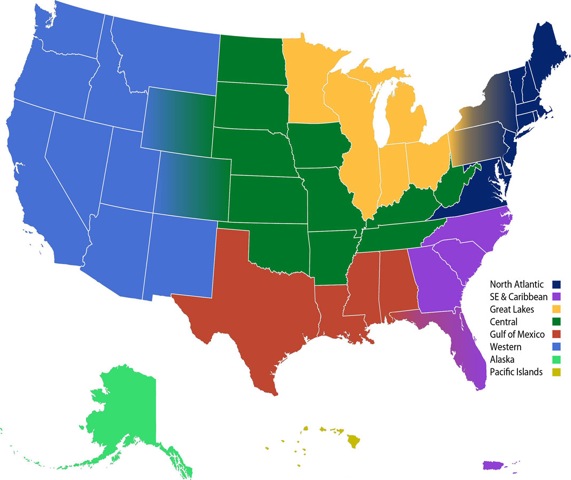
Each of the eight Regional Collaboration Teams (Alaska, Central, Great Lakes, Gulf of Mexico, North Atlantic, Pacific Islands, Southeast and Caribbean, and Western) is led by a senior integrator serving as the Regional Team Lead and assisted by a full-time Regional Coordinator. Regional Team Leads serve as a bridge between NOAA and regional leadership, and provide regional context to national messages with integrative components. Regional Coordinators develop, maintain, and mature regional internal and external networks. The Teams are comprised of NOAA staff and external partners (12-30 people) that are involved in regionally relevant programs.
Integrated services meeting the evolving demands of regional stakeholders
NOAA’s Regional Collaboration Network facilitates multi-disciplinary planning and execution on regional priorities, shares information and mobilizes knowledge and capabilities across the agency and throughout the country, and engages stakeholders to:
»Address NOAA mission priorities at appropriate geographic scales;;
»Address distinct regional challenges related to NOAA’s mission;
»Leverage current and emerging regional partnerships to respond to stakeholder needs; and
»Enhance NOAA’s value to and impact on the regions.
The guiding principles for regional collaboration offer an operational foundation for the effort:
»NOAA shall advance its goals for regional collaboration through existing authority and accountability structures. This effort does not entail changes to NOAA’s organizational structure;
»NOAA’s products and services shall be science-based and stakeholder-driven. The overarching purpose of regional collaboration is to improve NOAA’s productivity and value to customers; and
»Regional collaboration participants shall strive to identify, acknowledge, and apply NOAA’s full range of capabilities within and across regions to improve NOAA’s productivity and value to customers.
A NOAA-wide geographic framework was designed to engage stakeholders and partners and integrate across NOAA at regional scales, as depicted in Figure 2-3. Regional framework criteria include public perception of regional identity, alignment with existing NOAA capabilities and regional partners, ecosystem-related boundaries, Federal and state jurisdictions, size-manageability of regions, and the geographic dimensions of programmatic priority areas. The geographic framework is revisited as necessary to ensure it remains responsive to furthering the goals of NOAA’s regional collaboration effort.
Figure 2-3
Regional Collaboration Geographic Framework
NOAA advances regional collaboration through collaborative networks that link Line and Staff Offices on regional and national bases. Coordinating bodies have been established to advance and implement NOAA’s Regional Collaboration Network, as follows:
The EXECUTIVE OVERSIGHT GROUP (EOG) serves as the principal advocate for this effort within NOAA, provides high-level guidance on priorities and activities, and is responsible for the overall success of this effort. The EOG is comprised of NOAA’s Line and Staff Office leadership.
The OFFICE OF PROGRAM PLANNING AND INTEGRATION (PPI), the OFFICE OF POLICY, and the OFFICE OF COMMUNICATIONS AND EXTERNAL AFFAIRS serve as organizational focal points for the Network. The Regional Collaboration EOG is co-chaired by the Directors of PPI, Policy, and External Affairs, and the National Coordinator for Regional Collaboration supports the integration of the Regional Collaboration effort into the agency’s business practices.
REGIONAL COLLABORATION TEAMS are inter-Line Office collaborative groups that maintain a cross-organizational perspective, and actively engage internally and externally to support NOAA’s value in their region. Led by an EOG-approved Regional Team Lead and assisted by a full-time Regional Coordinator, the Teams provide a mechanism to enhance the effectiveness of Line and Staff Offices to which individual members belong. The cross-organizational structure enables the senior managers in the regions to identify areas of mutual benefit and leverage resources within their execution lines to better address regional needs. This coordination and collaboration among Line and Staff Offices ultimately improves the agency’s ability to meet its mission. Regional Collaboration Team Members possess a deep understanding of the unique customer needs of the region that enables them to better contribute to NOAA’s mission responsibilities within the region and affect the delivery of NOAA services in the region.
The Teams comprising NOAA’s Regional Collaboration Network work together at regional and national levels to ensure stakeholder needs are being heard across the agency, and collaborative opportunities with partners are maximized. Information, insights, and intelligence are transmitted through 1) informal networking by Line Office and Goal Team representatives within and across the Regional Collaboration Teams, 2) formal written documents, including a bi-monthly progress report and an annual landscape document that highlights regional drivers, assets, and key regional projects, and 3) standing meetings among the teams. These interactions support planning and execution functions in NOAA by facilitating regionally coordinated, near-term and future projects to meet stakeholder needs in the region.
The EOG and each Regional Collaboration Team communicate formally through standing meetings. These meetings occur both separately and as periodic joint meetings. Regional Team Leads and the Coordinators also meet with each other and/or PPI to ensure full communication among Regional Collaboration Teams, and between the Regional Collaboration Teams and the EOG.
EOG members are encouraged to meet regularly with their LO representatives on the Regional Collaboration Teams. These meetings inform the membership of current regional activities and promote cross-regional integration within a LO. Information gained from such interactions provides a regionally-integrated perspective when developing LO strategic plans and annual plans. LO representatives also serve as links to and from their respective LOs on a continuing basis.
Additional information about NOAA’s Regional Collaboration effort is available at www.regions.noaa.gov/main or by contacting the National Coordinator for Regional Collaboration within PPI.


